Business automation
What to Automate First in a Small Business
By Samy Nakach ·
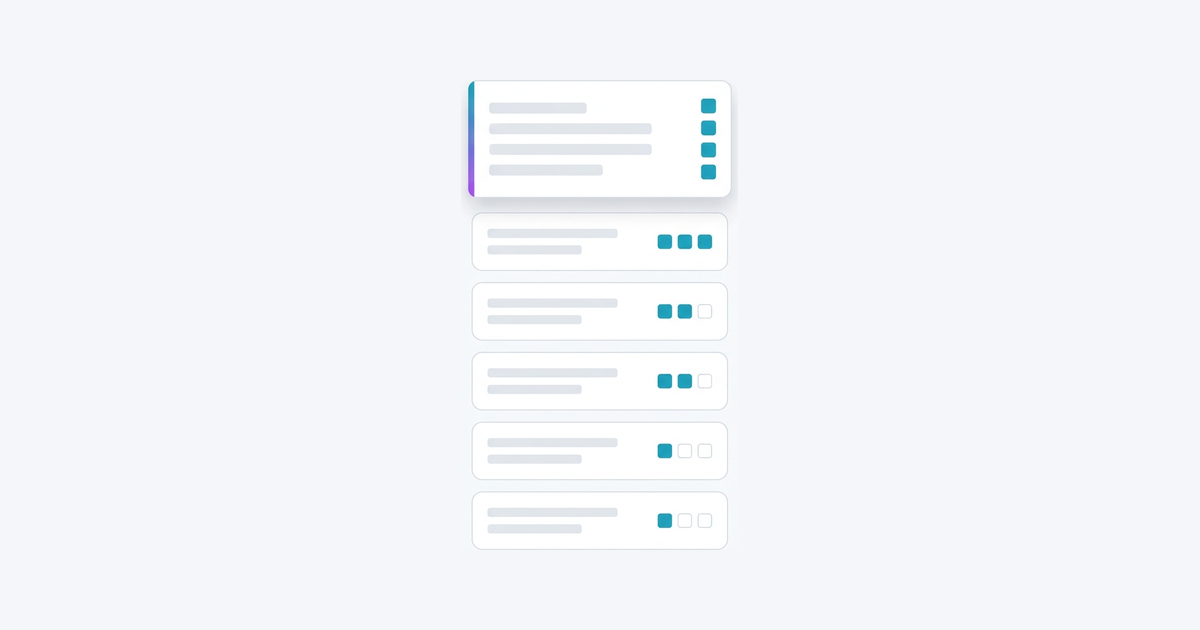
Pick the workflow that is boring, frequent, and already written down. Not the one that annoys you most.
TL;DR
The first automation in a small business should be chosen on four properties: how often it runs, how consistent its inputs are, how bad a wrong answer is, and whether the process already exists on paper. High frequency, consistent inputs, low cost of error, already documented. The workflow that scores well on all four is rarely the one the owner complains about — the loudest problem is usually the least automatable, because what makes it painful is exactly the judgement it requires.
The mistake almost everyone makes
Ask a business owner what they want to automate and you get the thing that ruined their week. A furious client. A quote that went out wrong. A hiring decision that took eleven meetings.
Those are bad first projects. Not because they are unimportant, but because the pain usually comes from ambiguity — competing priorities, incomplete information, a judgement call. Ambiguity is the one thing automation handles worst. You end up building something elaborate that gets it wrong in the cases you cared about, and the team quietly stops using it.
The workflows worth automating first are the ones nobody has strong feelings about. They are dull. They happen constantly. Everyone already knows the steps. That is exactly what makes them tractable.
The four properties that actually predict success
We ran a structured consulting engagement for a real-estate brokerage that was managing hundreds of listings across multiple markets. Property acquisition, listing management and client follow-up were all manual, and the team was drowning in coordination. Rather than guessing, we mapped every workflow and scored each one. Twelve processes, scored, roadmap delivered in three weeks.
The scoring came down to four questions.
1. How often does it run?
Frequency is the whole return. A task that takes forty minutes and happens twice a year is thirteen hours a decade — not worth building for. A task that takes ninety seconds and happens sixty times a day is a full-time job hiding in plain sight.
The instinct is backwards here. People nominate the long, painful tasks and skip the short ones. But short and constant beats long and rare, almost every time. Count the runs per week before anything else.
2. How consistent are the inputs?
A workflow that always begins the same way — a form submission, a WhatsApp message with predictable content, a PDF in a known format — is straightforward. A workflow that begins with "it depends how the client sends it" is not, and the variability will eat the project.
This is usually the property that kills otherwise attractive candidates. If the first step is a human deciding what kind of thing just arrived, automate the classification first and treat the rest as a separate project.
3. What does a wrong answer cost?
Some mistakes are free. If an AI agent mis-tags an inbound lead, someone re-tags it and the day continues. Some mistakes are expensive: a wrong number in an invoice, a misfiled patient record, a message sent to the wrong client.
This is not an argument against automating high-stakes work. It is an argument about sequencing. Start where errors are cheap, learn how the system behaves on your actual data, and move toward the expensive work once you have earned the confidence. Anything touching money, health or legal obligation needs a human check on the way out — and needs it designed in from the start, not bolted on after the first bad week.
4. Is it already written down?
If nobody can describe the process end to end, it is not a process — it is a habit, and it differs by whoever is doing it. Automating a habit means freezing one person's version of it and imposing that on everyone.
The good news is that writing it down is most of the work. Teams routinely discover the process was never agreed on in the first place. We have watched a documentation session resolve a disagreement that had been quietly costing hours a week, before anyone wrote a line of automation.
Score them, do not rank them by feeling
The scoring itself is unglamorous. List every recurring workflow. For each one, note the runs per week, whether inputs are consistent, what a wrong answer costs, and whether the steps are documented. Then look at what clusters at the top.
Two useful things happen. The first is a ranked shortlist. The second, and more valuable, is that the exercise surfaces work nobody had thought of as a process at all — the fifteen minutes every morning someone spends reconciling two systems by hand, which appears on no job description and in no software.
For a multilingual nonprofit coordinating immigration and settlement processes across Spanish, English and Portuguese, the mapping mattered more than the tooling. Their entire operation lived in spreadsheets. We restructured it into a three-pillar architecture and activated the AI features already available in the platform they were paying for. Three weeks, three languages, zero custom code. The win came from understanding the process, not from building something clever.
Where the candidates usually are, by function
Organizing by business function rather than by industry is deliberate. A bakery and a law firm have almost nothing in common as businesses, but their payment follow-up problem is close to identical. Function is the axis that transfers.
Customer service is the most common starting point and usually deserves to be. First response, qualification, appointment booking, reminders and follow-up are high frequency, have reasonably consistent inputs, and tolerate error well. What SMBs can automate in customer service goes into where the line sits.
Operations is where the hidden work lives — scheduling, intake, data entry, internal handoffs. Less visible than customer service, often larger. See scheduling and intake automation.
Finance has the clearest return and the highest cost of error, which makes it a question of sequencing rather than avoidance. Invoicing and payment follow-up covers where to draw the line.
Marketing is where lead capture and routing quietly leak revenue. We built a prospecting system that finds, qualifies and scores leads from Google Maps and enriches the CRM automatically: over 300 qualified leads a month and fifteen hours a week back, without hiring. Lead capture and follow-up has the detail.
What good looks like after ninety days
The first automation should be boring to talk about. Nobody demos it. It runs, the team stops thinking about the task, and the time shows up somewhere else.
The measurable signal is usually response time before it is cost. Cost savings take a quarter or two to become legible, because the hours freed get absorbed into other work before anyone counts them. Response time changes immediately and is easy to verify.
If after ninety days nobody can tell you what changed, the project picked the wrong workflow. That is recoverable, and it is cheaper to learn on something dull.
Related reading
- How to implement agentic AI for business growth — the difference between AI that answers and AI that acts, and when you need the latter.
- Our AI consulting engagements — how the mapping and scoring process works when we run it.
About the author
Samy Nakach: Co-founder and CEO of HeyFlou. Works with SMB teams on AI automation across finance, operations, customer service and marketing.